
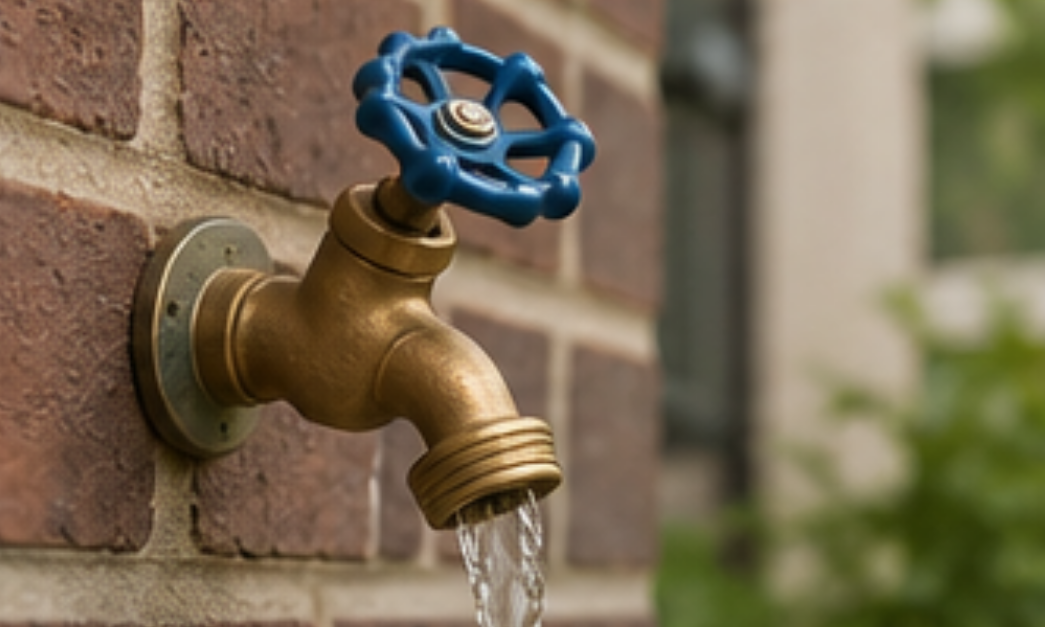
Outdoor faucets are more exposed to freezing temperatures than most indoor plumbing fixtures.
When water remains trapped inside the faucet or connected pipe, it can expand as it freezes. The resulting pressure may damage the faucet, split a pipe, loosen a fitting, or create a concealed leak that becomes visible only after temperatures rise.
Winter preparation should be completed before the first sustained freeze rather than after the faucet has already stopped working.
Remove garden hoses, splitters, timers, spray nozzles, and irrigation attachments from the faucet.
A connected hose can trap water inside the outlet and prevent the faucet from draining correctly.
Stretch the hose on a slight slope and allow the remaining water to leave.
Coil it loosely and store it away from direct sunlight, severe cold, and sharp objects. Inspect the connectors and washers before reusing it in spring.
Some outdoor faucets have a dedicated isolation valve inside the building.
It may be located in a basement, crawl space, utility room, cabinet, or near the point where the pipe passes through the exterior wall.
Turn the indoor shutoff valve fully to the closed position.
Do not force a valve that is seized or heavily corroded. A damaged shutoff valve may begin leaking around the stem and require professional replacement.
After closing the indoor valve, open the exterior faucet to release pressure and drain water from the line.
Leave it open during the winter when the plumbing arrangement and local instructions recommend this method.
Some interior shutoff valves include a small drainage cap.
Place a container beneath the valve, open the outdoor faucet, and carefully loosen the bleeder cap so trapped water can leave the pipe.
Retighten the cap after draining according to the valve instructions.
Check for dripping, loose fittings, cracked handles, damaged threads, and movement where the faucet enters the wall.
Seal air gaps around the pipe penetration with a material suitable for exterior construction. Cold air entering through a wall opening can lower the temperature around the indoor pipe.
A foam or insulated cover can reduce direct exposure to cold air.
The cover should fit securely against the wall without leaving large gaps.
A cover cannot reliably protect a water-filled pipe during prolonged severe freezing.
The more important steps are disconnecting hoses, shutting off the supply when possible, and draining the line.
A frost-free faucet places the shutoff point farther inside the heated part of the building.
When installed correctly, the remaining water drains from the outer section after the faucet is closed.
The faucet should normally slope slightly downward toward the exterior so water can drain.
A hose left attached, incorrect installation angle, or damaged internal component can prevent proper drainage even when the product is described as frost-free.
Some homes do not have a dedicated valve for each outdoor faucet.
In this situation:
Disconnect all attachments.
Confirm that the faucet closes completely.
Repair any drip before freezing weather.
Seal drafts around the pipe.
Install a suitable insulated cover.
Ask a plumber whether a shutoff valve or frost-free faucet should be added.
Do not attempt major pipe modifications without understanding the plumbing layout.
A Brass Outdoor Faucet is frequently selected because brass provides useful machinability, sealing performance, and corrosion resistance for water-control components.
Performance still depends on the alloy, wall thickness, internal valve structure, surface treatment, water quality, installation, and winter maintenance.
Our team can review outlet size, inlet connection, handle design, valve core, finish, and packaging for wholesale and project orders.
We supply bathroom and water-control products for distributors, project buyers, and private-label customers.
Product development can involve:
Connection standards
Body materials
Handle structures
Cartridge or stem systems
Surface finishes
Logo application
Accessory combinations
Retail or bulk packaging
Sample confirmation helps verify installation dimensions and operation before mass production.
Sourcing outdoor faucets for garden, utility, residential, or light commercial use?
Share your inlet and outlet sizes, valve type, material requirement, finish, climate conditions, packaging, and order quantity. We will prepare a Brass Outdoor Faucet solution for your market.
Previous: What Causes Bathroom Faucets To Corrode?

 Mobile Phone:
 Phone:
 Contact Now
 WeChat