
Touchless kitchen faucets work by using a sensor to detect your hand or an object near the spout and then opening an internal valve to let water flow. Instead of turning a handle every time, the faucet uses a small control system to decide when to start and stop water. In a busy kitchen, this helps reduce cross-contamination, keeps the faucet body cleaner, and makes rinsing, handwashing, and food prep faster.
HAOJIAJIA manufactures touchless solutions for residential kitchens and project applications, and supplies them through the touchless kitchen faucet product line. We also support OEM and ODM cooperation for customized requirements in hotel and construction projects.
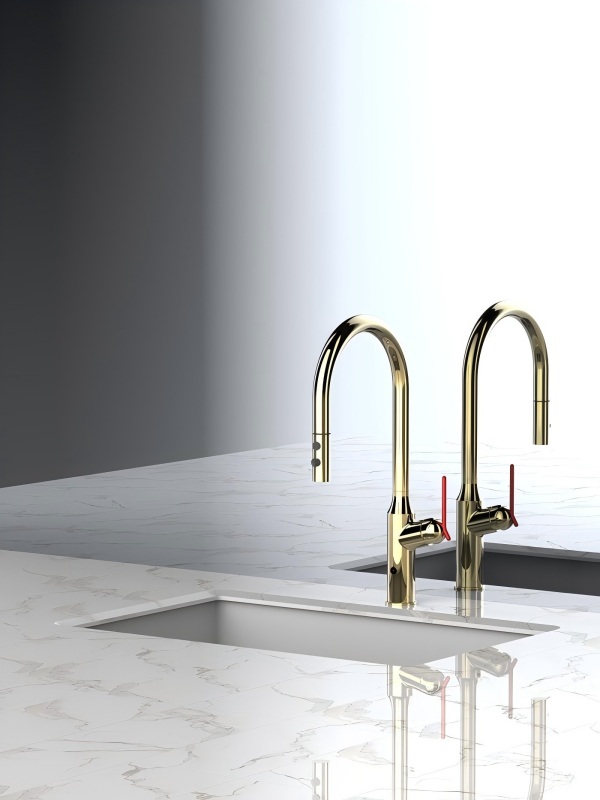
A touchless faucet is a combination of mechanical water control and electronic sensing. The main components work together in a simple sequence.
Sensor module
The sensor is usually placed near the spout base or the front of the body. It detects a change when your hand enters a defined sensing zone. When detection is stable, it sends a signal to the control unit.
Control unit
The control unit processes the sensor signal and applies timing and safety logic. It decides whether the faucet should turn on, stay on, or shut off. Good control logic helps avoid false triggering from random movement.
Solenoid valve
The solenoid valve is an electrically controlled valve inside the faucet water path. When the control unit powers it, the valve opens and water flows. When power stops, the valve closes and water stops.
Power supply
Touchless faucets commonly use battery power, hardwired power, or a combination depending on the model. Power stability matters because it affects responsiveness and long-term reliability.
Manual handle or backup control
Many touchless designs still include a handle for setting temperature or flow preference, and for manual use when needed. This makes the faucet flexible for different user habits.
The user experience feels instant, but the internal sequence is clear and predictable.
You move your hand near the sensing zone
The sensor detects a change in its field and confirms the presence of a hand or object.
The control unit confirms an intentional trigger
The control unit filters noise and brief movement so the faucet does not turn on from accidental passing motion.
The solenoid valve opens
The control unit energizes the solenoid, opening the valve and allowing water to flow through the faucet.
The faucet continues running while detection is maintained
If the sensor continues to detect presence, water keeps flowing. Some designs also use time-based logic to reduce unnecessary long running.
The solenoid valve closes when detection ends
When your hand moves away, the sensor no longer detects presence, and the control unit cuts power to the solenoid so the valve closes.
Touchless faucets are most useful when hands are messy, wet, or covered with ingredients. The sensor helps reduce contact with the faucet body, which is a common surface that collects residue.
Cleaner operation during raw food prep
If you handle meat, seafood, eggs, or oily ingredients, a touchless trigger reduces how often you touch the handle with contaminated hands.
Faster stop-and-start rinsing
Kitchen routines often involve short bursts of water for rinsing vegetables, cleaning knives, or washing hands. Touchless control reduces repetitive handle use and keeps workflow smoother.
Less handle-area buildup
Handles often accumulate soap residue, grease, and fingerprints. Reduced contact helps keep the faucet looking cleaner between wipe-downs.
The main difference is how the water valve is opened.
| Item | Touchless kitchen faucet | Traditional handle faucet |
|---|---|---|
| How water starts | Sensor signal opens solenoid valve | Hand turns handle to open cartridge |
| Main benefit | Reduced contact and faster workflow | Simple and familiar operation |
| Control style | Electronic trigger plus mechanical water path | Fully mechanical control |
| Best fit | Frequent cooking, high hygiene demand, projects | Low-use kitchens, minimal setup needs |
Does the faucet detect any movement
Most sensors detect within a defined zone, not across the entire sink area. Proper installation position and sensor design help keep detection focused on intentional use.
Does touchless control change water temperature
In many designs, touchless control triggers on and off, while temperature is set by the handle or mixing structure. This keeps temperature behavior consistent and easy to manage.
What happens during power loss
A well-planned installation includes a clear power strategy and routine battery replacement schedule if the model uses batteries. For projects, consistent configuration and maintenance planning reduce operational issues.
Is the water path still mechanical
Yes. Water still flows through internal channels, seals, and a controlled valve. Touchless functionality mainly changes the activation method, not the fundamental water delivery path.
Touchless performance depends on sensor position and correct assembly, especially in reflective sink environments.
Mounting position and sink reflectivity
Highly reflective stainless sinks can influence sensing behavior if the sensor zone is too wide. Correct alignment helps reduce accidental triggers.
Cable routing and power placement
Stable power placement and clean routing help reduce maintenance friction and keep the under-sink area organized.
Water pressure stability
Stable inlet conditions help provide consistent flow response after activation. In projects, consistent plumbing standards across rooms improves uniform user experience.
Touchless faucets are often selected in bulk for apartments, hotels, and commercial kitchens where consistent performance and supply coordination matter.
OEM and ODM cooperation
HAOJIAJIA supports OEM and ODM services for customers who need customized appearance, specification matching, branding, or packaging requirements for different markets and projects.
Custom logo and packaging options
For procurement that requires brand alignment, HAOJIAJIA supports customized logo options and practical packaging solutions, including protective packaging approaches suitable for export shipment.
Project-oriented delivery coordination
Hotel and construction projects often require sampling confirmation, stable specification control, and batch delivery planning. A supplier that supports these steps reduces procurement risk and helps keep installation schedules steady.
To view our available options and request project support, visit our touchless kitchen faucet page.
Touchless kitchen faucets work by combining a sensor, a control unit, and a solenoid valve to start and stop water automatically when your hand enters a sensing zone. This improves hygiene during cooking, speeds up stop-and-start sink tasks, and reduces handle-area buildup. For residential kitchens and project installations, selecting a well-designed touchless faucet and a supplier with OEM and ODM capability helps ensure consistent performance, easier procurement, and a better end-user experience.
Explore HAOJIAJIA solutions here: touchless kitchen faucet.

 Mobile Phone:
 Phone:
 Contact Now